

'It was in the Film Society more than anywhere else that young artists came together. It was through Dodds that I first met them. Very soon after I graduated, he invited me to a dinner he gave in a private room in the Burlington Restaurant to a group of young men whose mentor in some sense he was. Most of them were clerks in local government or industry. There were perhaps ten guests, among them the sculptor Gordon Herickx, who worked as a stonemason, Stanley Hawes, who became a documentary film director and worked first in Canada and then in Australia, the painter John Melville and his brother Robert, who became a distinguished art critic and whom I last saw a glimpse of in a television film about the British Surrealist movement; he was meditatively and seemingly absent-mindedly kicking a violin along a gutter in a street near Waterloo Station.'
Walter Allen, 'As I Walked Down New Grub Street'
The Birmingham Film Society was set up by two clerks from the city in 1931 to show films not scheduled in commercial cinemas. These mainly consisted of European features, experimental short films and social-realist documentaries. One of the founders was Stanley Hawes who after a few more years working for Birmingham Corporation, moved to London to work under the wing of John Grierson as a director and producer for Strand Pictures Ltd. He returned to the city for the Society's 50th meeting in November 1936 when he introduced 'Chapter and Verse,'a film about the history of writing and books which he had recently completed.

Stanley Hawes
The Society's first meeting was on 18th January 1931 at the Hampton Cinema, Livery Street. The evening began with an address from Paul Rotha of the London Film Group. The main feature was the 1920 German Expressionist film, The Cabinet of Dr. Caligari.
The Hampton no longer exists as a cinema. It was an old hall, built over the Great Western Railway line, small, stuffy, and uncomfortable with its seats of shiny leather and metal uprights; but the size suited the infant society, costs were low, and the management was sympathetic. Jack Williams, one of the owner's sons, was our projectionist; his brother Fred looked after the "house." Without the goodwill of the Williams family the Society could not have existed; without their helpful kindness it would not have lived long.
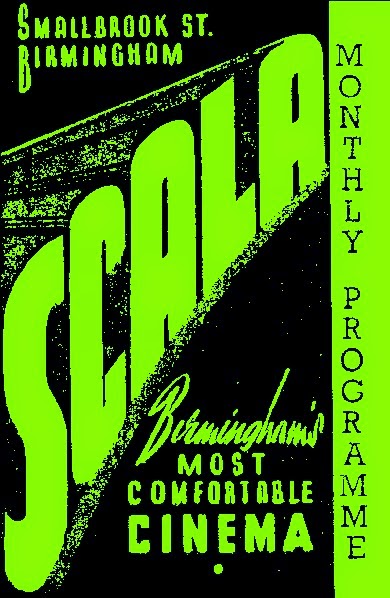
During the 1930s the Society moved to the Scala on Smallbrook Street and briefly to the West End cinema at the top of Suffolk Street as membership increased. The original and luxurious Scala closed in 1960 to make way for the development of Smallbrook Queensway. However a replacement cinema (below) was included, but that too closed in the late 1980s. The offices surrounding it are known as Scala House.
 |
| The former Great Hampton Picture Palace in 2015 |
The Hampton no longer exists as a cinema. It was an old hall, built over the Great Western Railway line, small, stuffy, and uncomfortable with its seats of shiny leather and metal uprights; but the size suited the infant society, costs were low, and the management was sympathetic. Jack Williams, one of the owner's sons, was our projectionist; his brother Fred looked after the "house." Without the goodwill of the Williams family the Society could not have existed; without their helpful kindness it would not have lived long.
from 'Flashback; A Hundred Shows of the Birmingham Film Society 1931-1948'
During the 1930s the Society moved to the Scala on Smallbrook Street and briefly to the West End cinema at the top of Suffolk Street as membership increased. The original and luxurious Scala closed in 1960 to make way for the development of Smallbrook Queensway. However a replacement cinema (below) was included, but that too closed in the late 1980s. The offices surrounding it are known as Scala House.
 |
| The replacement Scala cinema, now closed. |
Meetings were generally held on Sundays, although there were a few extra-ordinary gatherings on a weekday in an attempt to introduce discussion on film. For instance, W.H. Auden was enlisted to talk to the Midland Adult School Union at their hall on Severn Street alongside another showing of The Cabinet of Dr. Caligari, definitely one of the Society's most popular features.
 |
| The Cabinet of Dr. Caligari (1920) |
In the Society, Auden was amongst friends. E.R. Dodds was chairman from 1932 to 1936 then replaced by that other ringmaster of bohemian Birmingham, Philip Sargant Florence, and among the committee members were Gordon Herickx and Robert Melville whose brother John designed the logo.


No comments:
Post a Comment