Showing posts with label walter allen. Show all posts

Tuesday, 2 August 2011

Birth of the Birmingham Group


The Cabin, Union Passage, photographed in 1911

This week I received through the post, all the way from the Amazon, a copy of Leslie Halward's 1938 autobiography, Let Me Tell You. Unusually for an autobiography of a writer it was his second book and so it mainly focuses on Halward's growing up in Selly Oak, Birmingham. However, the later chapters are concerned with the beginnings of his writing career and in particular chapter XXI recalls the formation of the Birmingham Group of writers. Although the Group would sometimes be regarded as including WH Auden, Louis MacNeice, Henry Reed and even Henry Green, the core were those who met in a pub around Martineau Street in Birmingham's city centre during the 1930s - Walter Allen, John Hampson, Leslie Halward, Peter Chamberlain and very occasionally, Walter Brierley. I have often tried to ascertain exactly which pub it was and I am convinced it was The Cabin in Union Passage, seen above.

below are selected quotes from Chapter XXI of Let Me Tell You (1938) by Leslie Halward:

Now let me tell you about the "Birmingham Group," which, alas, exists no longer. The almost weekly meetings no longer take place in the upper room of a public-house off Corporation Street. Allen and Chamberlain have both gone to live in London; I am here in Malvern; only Hampson remains near the city.

In February, 1935, there appeared in New Stories a story by Peter Chamberlain called "Fanciful," and in the first sentence was a reference to the old Birmingham-Wolverhampton Road. I did not care much for the story, but the mention of the road, which I knew well, caused me to think that perhaps the author was a Birmingham man. At the same time I recollected that in his novel Saturday Night at the Greyhound John Hampson, also a contributor to New Stories, had written of the "good old Bull Ring." Perhaps he too lived in Birmingham. I decided to find out. I wrote to [Edward J.] O'Brien and he replied promptly, saying that certainly both Chamberlain and Hampson were Birmingham men, as also was Walter Allen, a story by whom had appeared in New Stories a couple of months before. O'Brien [editor of New Stories] was under the impression that we all knew each other.

On receipt of O'Brien's letter I wrote at once to both Chamberlain and Hampson and asked if I might meet them. Chamberlain's reply was very vague, intimating that it would not be a bad idea if we had tea together somewhere, some time. Hampson's was much more to the point. It began: "Do you know a pub off Corporation Street...?" went on to give very precise directions for finding the place, and stated that at seven o'clock on the following Thursday evening he and Walter Allen would be there. In order to avoid any confusion a copy of New Stories would be prominently displayed on their table.

I shall never forget the shock I received when I walked into that room and saw first the copy of New Stories and then the two men seated at the table on which it lay. My recollection of Saturday Night at the Greyhound and the opening sentence of Hampson's letter had caused me to expect to see a burly young fellow of thirty or so blowing the froth off a pint. I took one look at Allen, knew that he could not have written Saturday Night at the Greyhound, and found it almost impossible to believe that the other one could. A frail little gentleman he looked, at least forty-five years old, and he was toying with a glass that had a drop of whisky in the bottom. His hand was so small that my own enveloped it, wrist and thumb included, and as he made only a half-hearted attempt to rise I got the impression that he was an invalid or perhaps even a cripple. He introduced me to Allen and I sat down opposite them.

Well, that is how the Birmingham Group came to be formed. We four met more or less regularly at that public house and talked and talked and talked, as diverse a group of writers, as one newspaper has put it, as any part of the provinces can boast of.

Can it be wondered that we disagreed about a number of things, that arguments were inclined to be rowdy, that nearly always the lights were turned out on us before we realised that we were alone in the room and that it was time for us to go home. We never regarded ourselves as a group; it was left to O'Brien to so christen us; we were simply four young men who, having common interests and vaguely similar ideas, met periodically for the purpose of explaining each to the other where he was wrong.


Monday, 8 February 2010

Walter Allen


Walter Allen 1911-1995 

It is thanks to Walter Allen that we can spy in on some of the literary and artistic life of Birmingham in the 1930s. His Memoir of a writing life, As I Walked Down New Grub Street (1981) draws a picture of a city far from culturally stagnant, but one where the themes and concerns of the era are acted out, contemplated and reflected.
 
Born on Anglesey Street in the working-class Lozells district of Birmingham, Allen won a scholarship to King Edward's School, Aston before entering the University of Birmingham to read English. He was fortunate to have been taught by Annie Dodds (wife of E.R. Dodds), A.M.D. Hughes and Louis MacNeice, as well as the head of the Faculty, Ernest de Selincourt, though he bored Allen rigid. The Arts Faculty was then still based in the city centre in Mason College which stood where the Central Library currently stands. I write 'currently' as quite recently the library building, one of Birmingham's great architectural icons, has scandalously failed to be listed and will be demolished in 2013.
Mason College, Chamberlain Square
University was not just a place of learning for Walter Allen. Throughout his time there he also immersed himself in editing the university magazine, The Mermaid, joined the dramatic society and attended meetings of the Birmingham Film Society. Consequently he was befriended by E.R. Dodds.

Allen also had a short and disillusioning experience in student politics; an episode he would later describe as a farce, but it does shed some light on the rise of divisive politics at the beginning of an age of 'ferocious theologies.' This was in 1931 when many were disillusioned with the Labour Party after the General Strike and at the start of the Great Depression. Oswald Mosley, that most hated of British politicians, had a previous life as a Labour MP for nearby Smethwick (and a Conservative before that) but resigned in February 1931 in protest of Labour's inability to tackle the problem of unemployment. He immediately formed the short-lived New Party which set out to attract those who wished to split from Labour. Walter Allen was one of a small group of Birmingham University undergraduates who joined the local branch, chaired by former Labour MP for Aston, John Strachey who later became Minister for Food in the Attlee post-War Government. So when Mosley came to Birmingham Town Hall in September to make a speech at the invitation of the Communist Party, Walter Allen witnessed Mosley's journey into Fascism. The most shocking revelation of the New Party at that meeting for Allen was the presence of Mosley's "Biff Boys", his own militia led by the boxer Kid Lewis. It was not something that Allen could possibly tolerate, and so he and his fellow undergraduates headed to the Trocadero on Temple Street to drown their sorrows of naivety and foolishness as fighting erupted on New Street. 

After graduation Walter Allen continued with his ambition to be a full-time writer which was no small feat during the Great Depression. Although he was working on a novel in the background, he was a prolific writer of articles and essays  - a real jobbing writer. He contributed regularly to the Birmingham Post, the Birmingham Gazette, the Bookman, the Radio Times and the BBC Midlands service. For the latter Allen wrote and broadcasted a series of children's stories but as it did not pay well, he suggested a programme on Midlands authors which was accepted. The research brought him into contact with his subjects - W.H. Auden, Cecil Day Lewis, John Hampson and Henry Green - and helped cement relations between them. Of these, it was John Hampson who became the closest friend. In 1936 when Hampson was persuaded by Auden to marry Therese Giehse, Walter Allen took the role of Best Man. For those in attendance it was a fondly remembered and often recounted event, mostly for the surrealism. 

In 1938 Walter Allen's first novel, Innocence is Drowned, was published by Michael Joseph. It was the culmination of everything he had been working towards. Despite respectful reviews, it did not sell well, but Allen was following his dream of a life of a writer, and so he did what talented and ambitious creative people have done from the beginning of time - he moved to London, to a flat on the edge of Bloomsbury. However, he did not leave Birmingham totally behind him as the successors to his debut - Blind Man's Ditch (1939) and Living Space (1940) continued to draw on his own Birmingham upbringing, and this theme climaxed with what is generally regarded as his best novel, All In A Lifetime (1959).


'Mr. Walter Allen displays a rare appreciation of working-class life. He has a gift for terse, elemental writing not usually found outside the pages of American novelists.' 
Birmingham Gazette, 10 February 1938


Letter from Walter Allen to Annie Dodds, 1950


Walter Allen being interviewed by David Lodge for 'As I was walking down Bristol Street',
a documentary for TV reflecting on the Birmingham Group (dir: Jim Berrow, 1983).

Friday, 8 January 2010

Birmingham Film Society


'It was in the Film Society more than anywhere else that young artists came together. It was through Dodds that I first met them. Very soon after I graduated, he invited me to a dinner he gave in a private room in the Burlington Restaurant to a group of young men whose mentor in some sense he was. Most of them were clerks in local government or industry. There were perhaps ten guests, among them the sculptor Gordon Herickx, who worked as a stonemason, Stanley Hawes, who became a documentary film director and worked first in Canada and then in Australia, the painter John Melville and his brother Robert, who became a distinguished art critic and whom I last saw a glimpse of in a television film about the British Surrealist movement; he was meditatively and seemingly absent-mindedly kicking a violin along a gutter in a street near Waterloo Station.'
Walter Allen, 'As I Walked Down New Grub Street'

The Birmingham Film Society was set up by two clerks from the city in 1931 to show films not scheduled in commercial cinemas. These mainly consisted  of European features, experimental short films and social-realist documentaries. One of the founders was Stanley Hawes who after a few more years working for Birmingham Corporation, moved to London to work under the wing of John Grierson as a director and producer for Strand Pictures Ltd. He returned to the city for the Society's 50th meeting in November 1936 when he introduced 'Chapter and Verse,'a film about the history of writing and books which he had recently completed. 


Stanley Hawes

The Society's first meeting was on 18th January 1931 at the Hampton Cinema, Livery Street. The evening began with an address from Paul Rotha of the London Film Group. The main feature was the 1920 German Expressionist film, The Cabinet of Dr. Caligari.

The former Great Hampton Picture Palace in 2015

The Hampton no longer exists as a cinema. It was an old hall, built over the Great Western Railway line, small, stuffy, and uncomfortable with its seats of shiny leather and metal uprights; but the size suited the infant society, costs were low, and the management was sympathetic. Jack Williams, one of the owner's sons, was our projectionist; his brother Fred looked after the "house." Without the goodwill of the Williams family the Society could not have existed; without their helpful kindness it would not have lived long.
from 'Flashback; A Hundred Shows of the Birmingham Film Society 1931-1948'


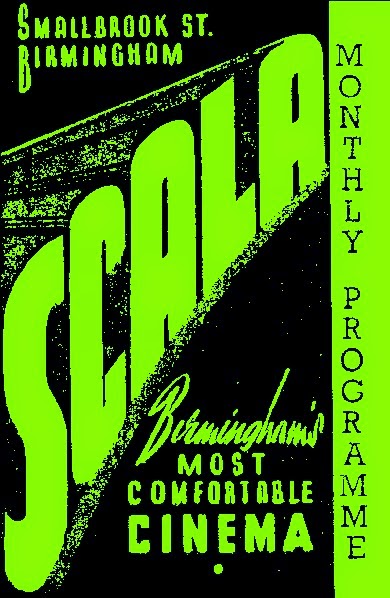
During the 1930s the Society moved to the Scala on Smallbrook Street and briefly to the West End cinema at the top of Suffolk Street as membership increased. The original and luxurious Scala closed in 1960 to make way for the development of Smallbrook Queensway. However a replacement cinema (below) was included, but that too closed in the late 1980s. The offices surrounding it are known as Scala House.


The replacement Scala cinema, now closed.


Meetings were generally held on Sundays, although there were a few extra-ordinary gatherings on a weekday in an attempt to introduce discussion on film. For instance, W.H. Auden was enlisted to talk to the Midland Adult School Union at their hall on Severn Street alongside another showing of The Cabinet of Dr. Caligari, definitely one of the Society's most popular features.


The Cabinet of Dr. Caligari (1920)

In the Society, Auden was amongst friends. E.R. Dodds was chairman from 1932 to 1936 then replaced by that other ringmaster of bohemian Birmingham, Philip Sargant Florence, and among the committee members were Gordon Herickx and Robert Melville whose brother John designed the logo.