Showing posts with label sargant florence. Show all posts

Wednesday, 3 February 2010

Louis MacNeice & Highfield


"The front door of my own home in England has no knob or handle on the outside at all; it can only be opened from the inside after an enormous bolt has been shifted. It is a mid-Victorian house built for security and privacy. At the entrance to the drive there is a great wooden gate which is so formidable that I doubt whether I should have the temerity to go in myself if I ever found it closed."
Lella Secor Florence, 'Our Private Lives' (1944)


Between 1930 and 1936, the Irish poet Louis MacNeice lived in a former coachman's dwelling (below) in the grounds of a home in Selly Park called Highfield, one of the large Victorian houses built in the 1860s on Selly Hill but demolished in 1984. MacNeice's home was known as Highfield Cottage which he shared with his wife Mary, and later with their son Dan.


From 1929 until its demise, Highfield was the home of Prof. Philip Sargant-Florence, Director of Social Studies at the University and Professor of Economics, with his wife Lella who 'had a charming smile, violent red hair and vitality,' according to MacNeice. She worked in Birmingham promoting family planning, and seems to have spent the 1930s using Highfield (below) as the centre of Birmingham's 'alternative Bloomsbury'.


Philip Sargant Florence had indeed lived in Bloomsbury before moving to Birmingham. His sister Alix was even more connected to the Bloomsbury Set, having married James Strachey in 1920. Together, Alix and James made the standard translation of Freud into English.


Philip, Mary, Anthony, Noel and Lella Sargant Florence with Alix Strachey (nee Sargant Florence)

MacNeice writes in his unfinished autobiography, 'Two or three times a summer they would lend their garden for Labour Party garden parties and our doorstep would be littered with orange peel... Our landlady's friends had a gospel-tent enthusiasm and quivers of prickly statistics.'


'Most English Left-Wing intellectuals and American intellectuals visiting Britain must have passed through Highfield between 1930 and 1950.'

Walter Allen, 'As I Walked Down New Grub Street.'

 The interior walls of Highfield were decorated with murals by the artist Joan Souter-Robertson, making it sadder to hear of its destruction. The address was 128 Selly Park Road, but the land is now Southbourne Close, an exclusive, private cul-de-sac. Residents there have access to what little remains of Highfield - the Southbourne Close Pool, one of a number of lakes which once existed across Selly Hill, and the pagoda which can be glimpsed behind trees from Kensington Road.


There was a scheme for Highfield in 1939 with the intention of Isokon building flats on Highfield's land. But the war intervened and Isokon could no longer operate. Here's a picture of what might have been, the Lawn Road flats, in Hampstead, London:


In November 1935, Mary MacNeice left Louis and Dan to be with Charles Katzman, a former American Football star who the MacNeices had befriended. The month previously MacNeice was driving Katzman back from Oxford and was about a mile away from Selly Park, when he crashed his Austin 7, throwing Louis and Katzman out of the vehicle.


Although MacNeice was able to walk home, Katzman was hospitalised but released after a few days. He continued his recovery at Highfield Cottage where Mary nursed him back to health, but also fell in love with him. This Ballardian collision was a blow to MacNeice who was in danger of having a breakdown according to his worried friends, but it was a gain to Birmingham. After Mary's departure, Louis became more involved with the city, spending more time with its writers and artists.

The spell of the Enchanted Island was broken when Mary left. Louis instigated divorce proceedings immediately. Mary's mother sent a nanny for Dan, but her real role was to seduce Louis into undermining his grounds for divorce. A year after Mary's departure, a year of 'intrigue, spiritual squalor and anxiety', Louis successfully applied for the position of lecturer in classics at Bedford College, London. After a trip to Iceland with W.H. Auden, which became the basis for the collaborative Letters from Iceland, a 'spectacular' farewell party was thrown at Highfield Cottage in the autumn of 1936. Walter Allen recalls it in his memoir, As I Walked Down New Grub Street:

[It] began about nine of a Saturday evening and for some of us, Louis included, did not end until more than twenty-four hours later. My memories of the party are appropriately hazy. Professor and Mrs Dodds were there at the beginning and so was Auden... Those who came from London included Spender, Rupert Doone, the director of the Group Theatre, which had recently staged Auden's and Isherwood's The Dog Beneath the Skin and was soon to do Louis's translation of the Agamemnon of Aeschylus, and the painter Robert Medley. I remember Doone, at one point during the night, sitting cross-legged on the floor and reiterating with great impressiveness, 'The theatre is like a basket of eggs: you take some out and you put some in.' I remember someone, for reasons best known to himself, throwing a glass of brandy on to the fire and a jet of flame shooting out and scorching the backside of the person standing in front of it, who I have always believed was Henry Reed. And I remember, as we woke up at first light from our impromptu beds on couches and blankets strewn on the floor, seeing Gordon Herickx standing at the window and surveying the grounds of Highfield, which must have been two or three acres in extent, and saying meditatively to himself: 'So this is how the poor live!'

Friday, 8 January 2010

Birmingham Film Society


'It was in the Film Society more than anywhere else that young artists came together. It was through Dodds that I first met them. Very soon after I graduated, he invited me to a dinner he gave in a private room in the Burlington Restaurant to a group of young men whose mentor in some sense he was. Most of them were clerks in local government or industry. There were perhaps ten guests, among them the sculptor Gordon Herickx, who worked as a stonemason, Stanley Hawes, who became a documentary film director and worked first in Canada and then in Australia, the painter John Melville and his brother Robert, who became a distinguished art critic and whom I last saw a glimpse of in a television film about the British Surrealist movement; he was meditatively and seemingly absent-mindedly kicking a violin along a gutter in a street near Waterloo Station.'
Walter Allen, 'As I Walked Down New Grub Street'

The Birmingham Film Society was set up by two clerks from the city in 1931 to show films not scheduled in commercial cinemas. These mainly consisted  of European features, experimental short films and social-realist documentaries. One of the founders was Stanley Hawes who after a few more years working for Birmingham Corporation, moved to London to work under the wing of John Grierson as a director and producer for Strand Pictures Ltd. He returned to the city for the Society's 50th meeting in November 1936 when he introduced 'Chapter and Verse,'a film about the history of writing and books which he had recently completed. 


Stanley Hawes

The Society's first meeting was on 18th January 1931 at the Hampton Cinema, Livery Street. The evening began with an address from Paul Rotha of the London Film Group. The main feature was the 1920 German Expressionist film, The Cabinet of Dr. Caligari.

The former Great Hampton Picture Palace in 2015

The Hampton no longer exists as a cinema. It was an old hall, built over the Great Western Railway line, small, stuffy, and uncomfortable with its seats of shiny leather and metal uprights; but the size suited the infant society, costs were low, and the management was sympathetic. Jack Williams, one of the owner's sons, was our projectionist; his brother Fred looked after the "house." Without the goodwill of the Williams family the Society could not have existed; without their helpful kindness it would not have lived long.
from 'Flashback; A Hundred Shows of the Birmingham Film Society 1931-1948'


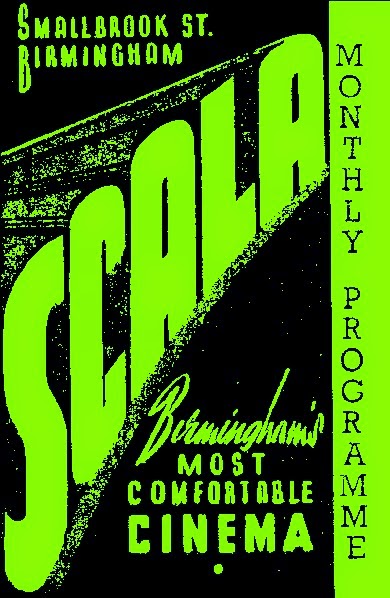
During the 1930s the Society moved to the Scala on Smallbrook Street and briefly to the West End cinema at the top of Suffolk Street as membership increased. The original and luxurious Scala closed in 1960 to make way for the development of Smallbrook Queensway. However a replacement cinema (below) was included, but that too closed in the late 1980s. The offices surrounding it are known as Scala House.


The replacement Scala cinema, now closed.


Meetings were generally held on Sundays, although there were a few extra-ordinary gatherings on a weekday in an attempt to introduce discussion on film. For instance, W.H. Auden was enlisted to talk to the Midland Adult School Union at their hall on Severn Street alongside another showing of The Cabinet of Dr. Caligari, definitely one of the Society's most popular features.


The Cabinet of Dr. Caligari (1920)

In the Society, Auden was amongst friends. E.R. Dodds was chairman from 1932 to 1936 then replaced by that other ringmaster of bohemian Birmingham, Philip Sargant Florence, and among the committee members were Gordon Herickx and Robert Melville whose brother John designed the logo.