Thursday, 14 January 2010

Things Being Various


'We had a miraculous stroke of luck. There came on the market - cheaply, since the Great Slump was on the way - a pair of small late Georgian houses in Sir Harry's Road in the inner part of Edgbaston, in those days only a penny ride from the City Centre; and at the same time Bet unexpectedly inherited from a childless uncle enough money to enable us to buy them. One of the pair was inhabited by an aged maiden lady; the other was vacant and became our home.'
E.R. Dodds, 'Missing Persons
 

Today I had the honour of being allowed into the former home of Professor E.R. Dodds and his wife Annie, fondly known as Bet to E.R. For this I am deeply indebted to Mrs B. Pugh who currently lives there. Professor Dodds lived in Birmingham from 1924 to 1936, and around him buzzed much of the cultural life of the city. Perhaps he is best known for his  close association with the poets Louis MacNeice and W.H. Auden, both of whom regularly hung-out at home with the Doddses.


Like the rest of the country, Birmingham is covered in snow at the moment which made it all the more fortunate for me to see 6 Sir Harry's Road in weather pertinent to the address. Here, Louis MacNeice, while sitting in Dodds's study (above) and gazing out to the garden, was inspired to write 'Snow' (January 1935).


Friday, 8 January 2010

Birmingham Film Society


'It was in the Film Society more than anywhere else that young artists came together. It was through Dodds that I first met them. Very soon after I graduated, he invited me to a dinner he gave in a private room in the Burlington Restaurant to a group of young men whose mentor in some sense he was. Most of them were clerks in local government or industry. There were perhaps ten guests, among them the sculptor Gordon Herickx, who worked as a stonemason, Stanley Hawes, who became a documentary film director and worked first in Canada and then in Australia, the painter John Melville and his brother Robert, who became a distinguished art critic and whom I last saw a glimpse of in a television film about the British Surrealist movement; he was meditatively and seemingly absent-mindedly kicking a violin along a gutter in a street near Waterloo Station.'
Walter Allen, 'As I Walked Down New Grub Street'

The Birmingham Film Society was set up by two clerks from the city in 1931 to show films not scheduled in commercial cinemas. These mainly consisted  of European features, experimental short films and social-realist documentaries. One of the founders was Stanley Hawes who after a few more years working for Birmingham Corporation, moved to London to work under the wing of John Grierson as a director and producer for Strand Pictures Ltd. He returned to the city for the Society's 50th meeting in November 1936 when he introduced 'Chapter and Verse,'a film about the history of writing and books which he had recently completed. 


Stanley Hawes

The Society's first meeting was on 18th January 1931 at the Hampton Cinema, Livery Street. The evening began with an address from Paul Rotha of the London Film Group. The main feature was the 1920 German Expressionist film, The Cabinet of Dr. Caligari.

The former Great Hampton Picture Palace in 2015

The Hampton no longer exists as a cinema. It was an old hall, built over the Great Western Railway line, small, stuffy, and uncomfortable with its seats of shiny leather and metal uprights; but the size suited the infant society, costs were low, and the management was sympathetic. Jack Williams, one of the owner's sons, was our projectionist; his brother Fred looked after the "house." Without the goodwill of the Williams family the Society could not have existed; without their helpful kindness it would not have lived long.
from 'Flashback; A Hundred Shows of the Birmingham Film Society 1931-1948'


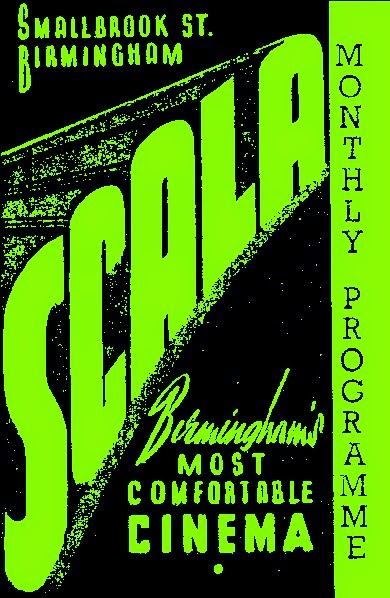
During the 1930s the Society moved to the Scala on Smallbrook Street and briefly to the West End cinema at the top of Suffolk Street as membership increased. The original and luxurious Scala closed in 1960 to make way for the development of Smallbrook Queensway. However a replacement cinema (below) was included, but that too closed in the late 1980s. The offices surrounding it are known as Scala House.


The replacement Scala cinema, now closed.


Meetings were generally held on Sundays, although there were a few extra-ordinary gatherings on a weekday in an attempt to introduce discussion on film. For instance, W.H. Auden was enlisted to talk to the Midland Adult School Union at their hall on Severn Street alongside another showing of The Cabinet of Dr. Caligari, definitely one of the Society's most popular features.


The Cabinet of Dr. Caligari (1920)

In the Society, Auden was amongst friends. E.R. Dodds was chairman from 1932 to 1936 then replaced by that other ringmaster of bohemian Birmingham, Philip Sargant Florence, and among the committee members were Gordon Herickx and Robert Melville whose brother John designed the logo.


Monday, 28 December 2009

John Hampson


John Hampson, 1901-1955

"His appearance was striking: he was plainly an unusual man. He had a large undershot jaw, deep lustrous brown eyes and brown hair that came down over his right temple like a lick of paint." 
Walter Allen, 'As I Walked Down New Grub Street'.


Letter from Walter Allen to John Cornish, 1977

Grandson of Mercer Hampson Simpson, manager of the Theatre Royal, Birmingham, John was born into a family that once had money, but by 1907 the family brewery business, co-owned by his father, also called Mercer Hampson Simpson, collapsed and the Simpsons slid into poverty.
After a home education, John began work in a munitions factory when he was thirteen. After a wide variety of low-paid employment and a short stretch in Wormwood Scrubs for book theft, John Hampson found himself the job around which he could apply himself to his vocation as novelist.


"A winding drive half a mile long brought us to Four Ashes. The facade was that of an Elizabethan cottage, which had been added to and enlarged. In front of it was a very small pond on which moorhens were nesting, and it was surrounded by a garden of several acres, with orchard and paddock." 
Walter Allen, 'As I Walked Down New Grub Street.'


In 1925 Hampson was employed by Mr & Mrs Wilson to tutor and nurse their son Ronald who had Down's Syndrome.  As part of the job Hampson lived with the family at Four Ashes, Dorridge. He had enough time to himself in this rural retreat to devote himself to his craft. The result was the publication of Saturday Night at the Greyhound, which sold well for Virginia and Leonard Woolf's Hogarth Press.


Although Hampson's early success had brought him some interesting acquaintances such as E.M. Forster and Graham Greene, he didn't really know anyone in Birmingham, and the joys of his success were left unshared until Walter Allen approached him for a BBC radio programme on Midlands writers. Allen found that Hampson's room at Four Ashes had become a shrine to himself, with photographs and newspaper cartoons of Bloomsbury parties. Hampson would later add to the collection a portrait by John Melville and a bust by Gordon Herickx. Not put off, Walter Allen and John Hampson became friends and would meet every Thursday in Birmingham; Central Lending Library, Boots Library, cafe, pub, then tea at the Burlington Restaurant.
Through Walter Allen, John Hampson's Birmingham became a more interesting place, "I introduced him to my friends, to Auden and MacNeice and Professor Dodds and to Herickx and the Melvilles, and later to Birmingham journalists and to people in the BBC." In return Hampson introduced Allen to E.M. Forster and William Plomer when they were staying at Four Ashes, and he also wrote him a letter of introduction to Graham Greene.
Their Thursdays together continued into 1934 when they were joined regularly by other members of the Edward J. O'Brien-named Birmingham Group in a pub off Martineau St. [The street as well as the pub have long since vanished by redevelopment.] It had been presumed by the American O'Brien that the Birmingham writers must have known each other and form a cohesive scene, but they came together afterwards. And so Hampson and Allen were joined by Leslie Halward and Peter Chamberlain.

The public school educated Chamberlain was perhaps the antithesis of the proletarian writer which it was expected of Birmingham to produce. Allen thought him smug and arrogant, nevertheless their association continued over the years. Halward, on the other hand, was the closest to being a voice of the working man.


In 1936, John Hampson married Therese Giehse, a Jewish-German actress working in a cabaret written with contributions from Auden who had married Thomas Mann's daughter and Therese's friend, Erika Mann. Hampson, homosexual, was persuaded by Auden to help Therese get a British passport (above) to escape from the Nazis. Auden argued, "What are buggers for?" And Hampson agreed. Three years previously Hampson had travelled to Berlin to cover the Reichstag Fire Trial for New English Weekly, and the experience had made him a passionate anti-Nazi.


"[Hampson] was a generous man and as honest as he was generous; and everything he knew he had learned himself. He owed nothing to schools or universities. Some of his weaknesses as a novelist may be due to that, but it also gave him strength."
Walter Allen, 'As I Walked Down New Grub Street'


Bibliography

Saturday Night at the Greyhound (1931)
O Providence (1932)
Strip Jack Naked (1934)
The Family Curse (1936)
The Larches (with L. A. Pavey) (1938)
Care of "The Grand" (1939)
The English at Table (1944)
A Bag of Stones (1952)


Saturday, 19 December 2009

Living in Birmingham


Henry Green

The novelist Henry Green was born Henry Yorke in Tewkesbury, 1905, and died in London, 1973. In 1926 Eton-educated Henry dropped out of Oxford University where he seems to have spent most of his time drinking and not getting on with his tutor C.S. Lewis. It was time to learn the family trade. When Vincent Yorke married Henry's mother Maud, his father was given the Birmingham foundry H. Pontifex & Sons based at Farringdon Works, Tyseley, in Birmingham. 


The site of Farringdon Works, 2009.

In January 1927 Henry moved to the city to work there initially as a stores labourer and then later as a pattern maker. During his two years at Farringdon Works, he lived in Stockfield Hall, a large Victorian boarding house located near Acocks Green on the Stockfield Road, seen below in 1941.


Henry Yorke, labourer, was already Henry Green, novelist, having written his first novel, 'Blindness' (1926), while still at Eton. His fellow workers in Birmingham assumed Henry was being punished by his father but Henry Green was observing and absorbing himself in the life of the factory. The result was his second novel, 'Living' (1929).


The site of Stockfield Hall, 2009.


Some footage of Birmingham in the 1920s: